
 If you want to have the ability to increase your golf swing speed and hit longer tee shots, one of the best things you can do is increase your strength.
The problem is that most people and golfers don’t really understand the concept of strength training.
With that in mind, I thought I would share a few principles of strength training.
Strength training principle #1
The first principle of strength training is that you need to apply training stress to your body.
You then need to rest in order to recover from that stress.
The body then adapts through a combination of increased muscle tissue, bone density and stronger connective tissues (ligaments, cartilage).
You are then ready to train the body again and apply more stress.
In the initial phase of strength training, a novice trainee can add weight to the bar each workout, if they started with conservative weights.
Over time, as the trainee gets stronger, it will be more difficult to add weight to the bar each workout.
The goals will then change to increasing the load each week, and then eventually for advanced competitive lifters, the goal is to peak for a performance annually.
The vast majority of golfers will never get to that level, and that is fine.
A new trainee can increase their strength considerably over the course of six months to a year, and then change their program to maintain their strength, or increase their strength much slower over time.
The issue is this… in order to make strength gains, you’ll need to lift heavy weight.
While you can certainly get stronger from lifting lighter weights, you can’t increase your strength as fast, and you will never achieve your strength potential that way.
Strength Principle #2
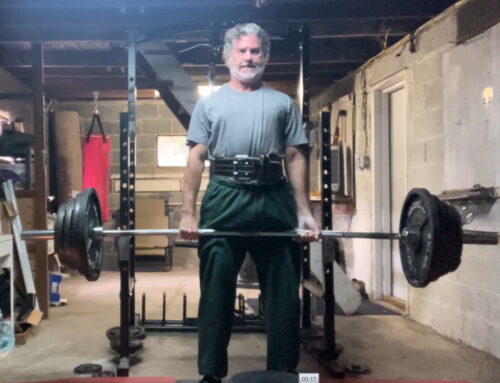
Legitimate strength training involves basic compound movements that mimic natural human movement patterns. These compound movements are performed with barbells.
Training these exercises with barbells will allow you to improve your strength faster than with any other exercises because they can be loaded with more weight.
For instance, you will improve your leg strength much faster by training the barbell squat than with leg extensions. The squat incorporates far more muscle mass and can ultimately be loaded with far more weight.
Unfortunately, most of the personal training and medical community advises most trainees against training these exercises.
This is mainly due to ignorance and lack of knowledge on how to coach the movements so that the trainee can avoid injury.
Jonathon Sullivan is a medical doctor who now specializes in training people over the age of 50 to get strong through the use of barbell training. Along with Andy Baker, he wrote “The Barbell Prescription” and he has clients as old as 94 that he trains at his Greysteel practice in Michigan.
Even if you have some sort of restricted movement due to an old injury, or perhaps arthritis, you can still likely train at least one or two of the primary compound movements.
The percentage of people who should avoid a particular exercise is actually pretty low.
With this in mind, do not just avoid these exercises because you are afraid of injury. This is why we start with low weight so we can learn the proper form.
Anyhow, the four main compound exercises include:
- Barbell Squat
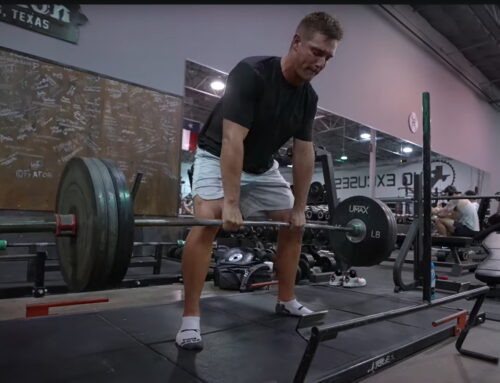
- Deadlift
- Bench Press
- Overhead Barbell Press
All these movements involve multiple muscle groups and joints, and therefore, involve far more muscle tissue compared to such exercises as dumbbell curls.
That is why performing these exercises with proper programming will allow you to build the most amount of strength over the shortest amount of time.
With that said, the squat, deadlift and overhead press are technical lifts that may require you to get some coaching to be sure to help you understand how to perform them.
Strength Training Principle #3
How many sets and reps should you train to build strength?
This depends upon your training level, but we will focus on the novice trainee here.
To build strength, we need to expose our body to intensity, or heavy weight. As a result, we tend to train with fewer reps.
Starting out, our focus is on five reps.
Here’s why…
Consider the two ends of the spectrum when it comes to training.
At the low end is 1 rep, and at the high end, we’ll use 20 reps. 20 reps is often employed by the bodybuilding community, which is focused on muscle hypertrophy.
Powerlifters train to have the ability to lift a maximum weight for a single rep. This is effectively just a performance.
A true one rep maximum weight will likely require so much effort, that the rep may take 5 to 7 seconds to complete.
After completing that rep, it will be impossible to immediately complete a second rep at that weight.
At the other end of the spectrum is the 20 reps.
Now, after you’ve completed 20 reps, chances are, if you take a couple deep breaths, you can squeeze out another rep or two.
At this point, it is no longer maximum force production at work, but muscle endurance.
In between this rep range is a number that will result in the following training adaptations:
- Increased strength
- Increased muscle mass
- Improved conditioning
That rep range is right around five reps.
After you’ve been training for a couple months and the weight on the bar has increased quite a bit, you will find that pushing out the fifth rep will be quite difficult.
It may take you a few seconds to complete the rep, and once done, you will be huffing and puffing.
This is particularly the case with the squat and deadlift, since there is so much muscle mass involved.
In general, novice lifters will make significant gains in strength over the span of a few months simply by performing THREE working sets of FIVE reps.
The lone exception is that we initially only train one working set of five reps on the deadlift, since it puts more stress on the nervous system than the other lifts, due to the weight on the bar and the number of muscle groups involved in the lift.
When training in this manner, we typically train three days per week, with at least a day of rest in between each strength training session.
Final thoughts
Golfers should approach their fitness like any other athlete and avoid the “golf specific” fitness nonsense.
It is encouraging to see that some top tour players are starting to see the light and are rejecting “golf specific” fitness in favor of legitimate strength training.
They then work on their games at the golf course, not in the gym.
If you are new to strength training, you will be amazed at how quickly you can build strength.
This will translate into the ability to generate more power with your golf swing.
If you are ready to get started, I’ve put together a complete strength and fitness program to help you build strength, improve your mobility, and lose weight if needed.
You can check it out here.
Now, get to work!